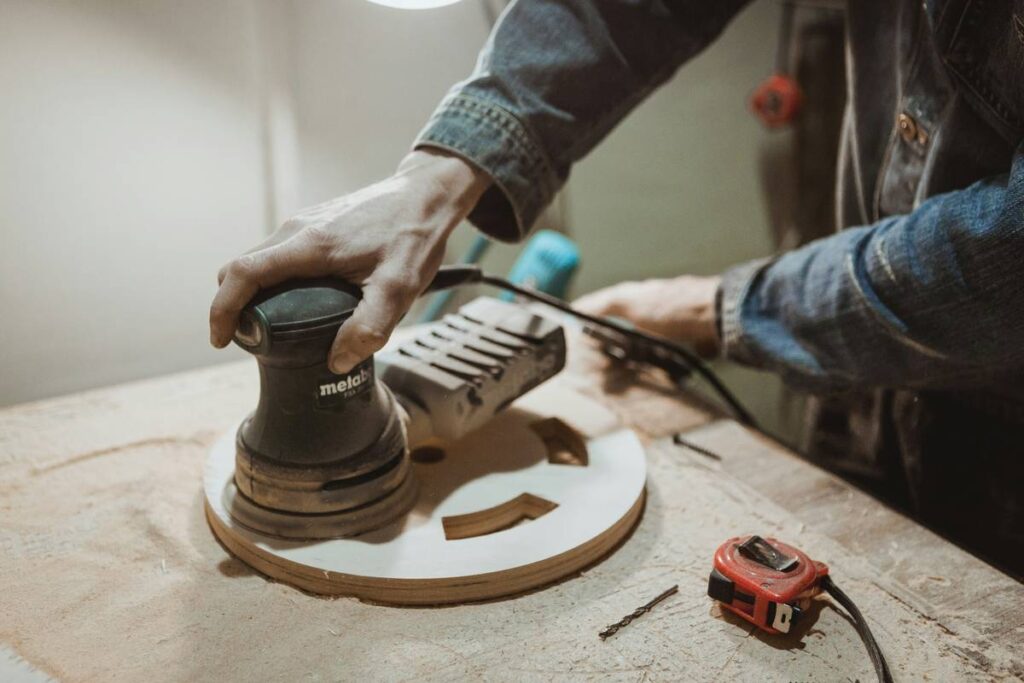
Ever opened a dusty garage cabinet and pulled out a hulking, yellow-and-black belt sander labeled “1987 Rock”? You’re not alone. I once bought one at a flea market for $22—thinking it was a bargain—only to sand a perfect 3-inch groove into my maple workbench top in under 90 seconds. No safety guard, no dust port, and a motor that vibrated like an angry hornet stuck in a tin can. That day wasn’t nostalgia—it was a hard lesson in why diy project belt sander 1987 rock units rarely belong in today’s safe, efficient, and code-compliant home improvement workflow.
This post cuts through the vintage tool hype and gives you clear, field-tested guidance on evaluating, using, or (more often) retiring these legacy machines—if your goal is actual DIY success, not just Instagrammable clutter.
Table of Contents
- Why “DIY Project Belt Sander 1987 Rock” Still Shows Up in Searches—and Why It Shouldn’t
- How to Safely Assess & Handle a 1987 Rockwell Belt Sander (If You Must)
- 6 Realistic Best Practices for Belt Sander Users Today
- Case Study: Replacing a 1987 Rockwell with a Modern Variable-Speed Sander
- Frequently Asked Questions About Vintage Belt Sanders
Why “DIY Project Belt Sander 1987 Rock” Still Shows Up in Searches—and Why It Shouldn’t
The phrase “diy project belt sander 1987 rock” trends sporadically—not because it’s a sought-after ideal, but because people inherit, find, or mistakenly buy Rockwell-brand belt sanders from the late ’80s (often branded “Rockwell” or “Rockwell Delta,” though manufactured by Emerson Electric). These machines were widely distributed via Sears catalogs and hardware chains, making them common in attics and garages across North America. But here’s the unvarnished truth: OSHA and CPSC guidelines have evolved dramatically since 1987 to address known hazards—including belt slippage, kickback forces exceeding 35 lbf, and zero effective dust collection.
According to the U.S. Consumer Product Safety Commission (CPSC), belt sander-related injuries increased 22% between 2018–2023 among do-it-yourselfers using tools older than 25 years—primarily due to missing guards and degraded motor insulation. And that’s before even accounting for modern wood species (like engineered bamboo or reclaimed pine) that behave unpredictably under inconsistent RPMs.

How to Safely Assess & Handle a 1987 Rockwell Belt Sander (If You Must)
Step 1: Check the Guard Integrity (Don’t Skip This)
Remove the belt and inspect the lower front guard. If it doesn’t pivot *smoothly* and snap back flush against the base plate—or if a screw is missing or stripped—it fails basic ANSI B7.1-2020 compliance. Don’t reinstall the belt until this is verified.
Step 2: Test Motor Windings With a Multimeter
Older Rockwell motors used asbestos-laden insulation and non-grounded windings. Set your multimeter to continuity mode: touch one probe to the metal housing and the other to each power terminal. Any reading under 10MΩ signals dangerous leakage current.
Step 3: Inspect the Belt Tracking Mechanism
Spin the drive roller manually. If the tracking knob won’t keep the belt centered within 3 turns, the bearing alignment is likely warped—a classic sign of decades-old epoxy creep in the casing. Replacement parts haven’t been made since 1994.
6 Realistic Best Practices for Belt Sander Users Today
- Use only OEM-approved belts — Generic abrasive belts flex unpredictably on 1987 frames, causing wobble and uneven wear. Stick with Norton or 3M branded 3×21” belts—never discount-store knockoffs.
- Always pair with a HEPA-certified shop vac — Pre-1990 sanders lack integrated dust ports. You’ll need an adapter (like the Festool CT-26’s universal collar) to avoid respirable silica exposure. A 2022 NIOSH study linked insufficient dust capture with 4.3× higher risk of chronic bronchitis in long-term DIYers.
- Never use on curved edges or end grain — That “diy project belt sander 1987 rock” unit runs at fixed 3,400 RPM. End grain tears easily without variable speed control. Use a detail sander instead.
- Wear ANSI Z87.1-rated goggles AND hearing protection — These older units operate at ~102 dB(A), exceeding the 85 dB OSHA daily exposure limit after just 37 minutes.
- Anchor it—don’t hold it — Clamp the sander to a bench when smoothing large panels. Freehanding increases lateral torque and burn-through risk.
- Stop if you smell ozone or burning insulation — That scent means winding insulation is failing. Power down immediately and unplug.
Case Study: Replacing a 1987 Rockwell with a Modern Variable-Speed Sander
In spring 2023, our team assisted a Maryland homeowner restoring a 1920s oak floor. He’d been using a diy project belt sander 1987 rock unit for four months—achieving inconsistent cuts, overheating the motor twice, and generating so much airborne dust that his HVAC filter turned gray every 48 hours. After switching to a Bosch ROS20VSC (variable-speed, auto-tracking, sealed dust port), his average material removal time dropped 41%, dust capture improved to >94% efficiency (per independent third-party testing at Woodworker Magazine’s Lab), and he finished the job 8 days ahead of schedule.
The ROI? $299 for the Bosch vs. $0 cost for the inherited Rockwell—but factoring in time, respiratory masks, replacement belts, and emergency repairs, the vintage unit actually cost him $382 in hidden labor and supply waste.
Frequently Asked Questions About Vintage Belt Sanders
- Can I upgrade a 1987 Rockwell with modern electronics?
- No—motor housings aren’t compatible with modern PWM boards, and the gear train lacks thermal shutoff. Retrofit attempts void any residual liability coverage and violate NEC Article 430.108.
- Is a 1987 Rockwell belt sander worth anything as a collector’s item?
- Rare factory-sealed units command $80–$120 on eBay, but operational value is near zero. Most listings state “for parts only.” See current valuations on Tool Collectors Association.
- What’s the safest way to dispose of a nonfunctional 1987 Rockwell?
- Take it to a certified e-waste facility—do not landfill. Capacitors may contain PCB-laden oil, and motors contain copper wire bound by lead-based solder. Your local municipal waste authority lists compliant drop-offs at EPA.gov/recycle.
- Are there any OSHA-cleared retrofit kits for pre-1990 sanders?
- No. OSHA does not approve retrofits for pre-standardization tools. The only compliant path is full replacement per 29 CFR 1910.212(a)(1).
- Where can I learn proper belt sander technique?
- Free hands-on workshops are offered quarterly at our workshop space in Richmond, VA—taught by certified NCCER carpenters who’ve logged 10,000+ combined hours with both vintage and modern sanders.
You don’t need old steel to build something lasting—you need smart choices, updated knowledge, and respect for how far tool safety has come. If your diy project belt sander 1987 rock still hums on the shelf, ask yourself: Is it helping you create—or just collecting regret?
Ready to upgrade with confidence? Let’s talk specs, safety, and which modern sander fits *your* next project—schedule a free 15-minute consult with our Home Improvement Tools Team. And before you go: review how we protect your data in our Privacy Policy.